by Francesca Pierini (Asian University for Women)
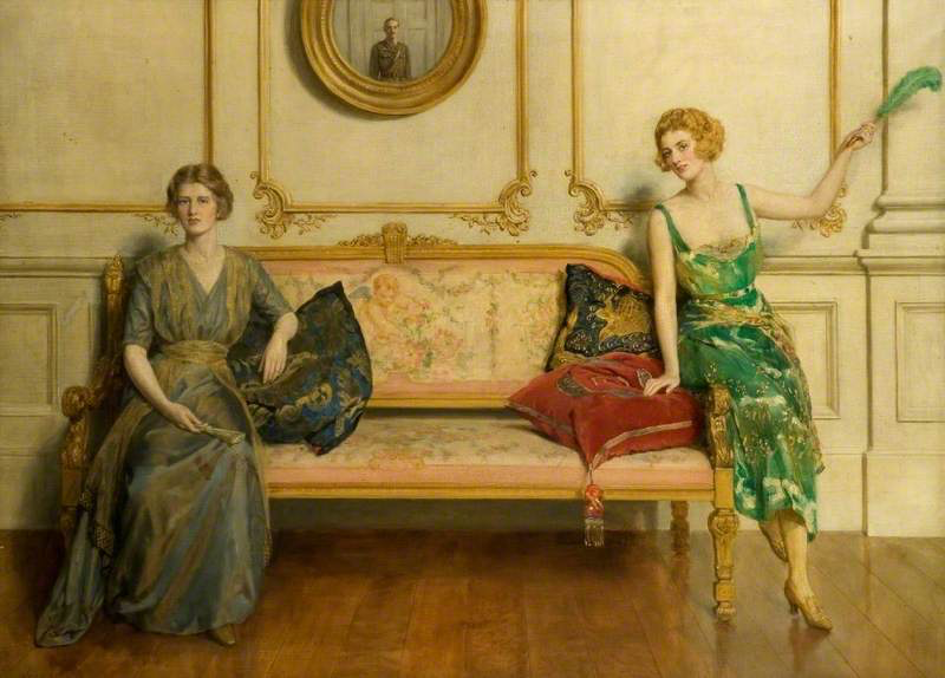
© John Collier (1850-1934), Sacred and Profane Love. Image reproduced with the kind permission of Northampton Museums and Art Gallery.
Abstract
George Eliot’s last novel, Daniel Deronda, was first published in eight instalments from February to September 1876. The novel’s treatment of emerging Zionism has perhaps protected it from relaxed critical approaches, and the 150th anniversary of its publication falls at a time that makes an equanimous and detached revisiting of its themes even more problematic. Daniel Deronda’s exclusion from untroubled appraisals is understandable, but unfortunate, because apart from the thorniness of some of its core themes – Judaism and a Jewish homeland in Palestine – the narrative still speaks to us through the extraordinarily three-dimensional power of its characters.
…..
A newly-released BBC Arts doc miniseries on Jane Austen, engaging and well-crafted, presents her work in a post-orientalist key, attributing to the author the conscious intention of questioning the British imperial subjugation of its colonies in Mansfield Park (1814), for instance, and attributing the novel’s lack of success – in Austen’s lifetime – to a precocious critique of imperialism articulated in quintessentially contemporary terms.
There are ample possibilities to apply a similarly contemporary lens to Daniel Deronda (1876) in updated appraisals/adaptations of the novel. This is because Daniel Deronda elaborates upon eminently current issues, such as, for instance, individual identity and belonging (to a political/religious community) as a dynamic process, determined by birth but also partly chosen and existentially pursued: “I want to be an Englishman,” Daniel tells Sir Hugo Mallinger, his adoptive father, “but I want to understand other points of view. And I want to get rid of a merely English attitude in studies” (152).
Daniel’s existential quest eventually leads him to discover his Jewish origin, which is the reason for his restlessness and lack of perfect alignment with his “too English” surroundings. Daniel’s choice of a Jewish wife – beautiful and talented Mirah Lapidoth – eventually reflects his newly-found identity, subsequent pacification with the world, and desire to explore and embrace his heritage.
Throughout the novel, however, Daniel is torn between Mirah and Gwendolen Harleth – spoiled, selfish, entitled, neurotic, speaking words that “were usually worse than she was” (221). Gwendolen, in fact, is not nearly as cunning and superficial as she seems. She has a “belief in her own power, but no cold artifice for the sake of enslaving” (342).
When Gwendolen is free to remarry, after the death of her ill-chosen husband – Henleigh Grandcourt – Sir Hugo is not alone in being somewhat surprised at Daniel not proposing to her. The reader too perceives that the complexity of character affiliating Daniel to Gwendolen, their shared restlessness, Daniel’s attraction to her, and Gwendolen’s dependence on him to guide her in finding a more genuine relationship to herself, should be sealed in marriage.
Moreover, Daniel and Gwendolen’s relationship to one another – chiefly developed through stolen dialogues and short encounters – is explored in much more detail than Daniel’s relationship to Mirah. But Daniel rejects Gwendolen, and, with her, English privilege and insularity, Victorian antisemitism, self-entitlement, “superannuated customs and false ambition” (205).
In her first marriage, Gwendolen chose rank, wealth, and a tainted husband over Rex Gascoigne, a candid young man who loves her passionately. In choosing pure, guileless Mirah over Gwendolen, Daniel does not repeat Gwendolen’s mistake. He marries more than a woman, namely a political and existential cause which signifies his renouncing of the world he partly belongs to, and partly despises.1
Daniel Deronda’s Gwendolen and Mirah embody profane and sacred love, and Daniel is attracted to both in different ways: Gwendolen’s power on him is immediate and magnetic; Mirah – an accomplished singer – seduces him with the gentle song of his long-lost ancestry, a call to everything noble he could accomplish as an English-educated Jew.
Not only do Mirah and Gwendolen respond to a symmetrical schema vis-à-vis personal characteristics and their position in relation to Daniel; they also occupy not just different but even opposed positions in relation to personal freedom and self-realization. If Daniel, as a young gentleman, is free to go on a personal quest interrupting and resuming his studies as he pleases, Mirah is forced by her father – who exploits her artistic talents – into a nomadic life away from home. Gwendolen is certainly the most frustrated of the trio, in her artistic ambitions as well as in her desire to explore the motives behind her disquiet:
We women can’t go in search of adventures – to find out the North-West Passage or the source of the Nile, or to hunt tigers in the East. We must stay where we grow, or where the gardeners like to transplant us. We are brought up like the flowers, to look as pretty as we can, and be dull without complaining. That is my notion about the plants, they are often bored, and that is the reason why some of them have got poisonous (110).
The two young women’s opposed situations – Mirah’s greatest wish is to be reunited with a long-lost mother; Gwendolen’s mother is omnipresent, passively oppressive and influential to Gwendolen’s choices – make up a dichotomous pair in which Mirah is, unexpectedly, the more experienced, the worldly-wise, and the well-travelled. She has lived irregularly, in close contact with dubious places and people, all along preserving a core of immaculate innocence – “She is a pearl: the mud has only washed her” (184).
Gwendolen, despite her self-confidence and worldly manners, is, by contrast, profoundly inexperienced. Unresolved and capable of dishonesty – mostly to herself – she is, to Daniel, nevertheless a temptress – frequently compared, in the first book, to a serpent (pp. 7 and 13), qualified as “double” (40), as retaining a trace of “demon ancestry” (54), a “young witch” (62), a creature with a “biting look” (106), all epithets aligning well with the “poison” of the passage quoted above.
Daniel saves both women in different ways, creating an enduring bond with both. Mirah has nothing to begin with, but she ends up with all Gwendolen desires – Daniel and the personal talents that guarantee her financial independence. Gwendolen begins as a “spoiled child” – the title of the novel’s first book – to lose, over the course of events, all the “superior claims which made a large part of her consciousness” (11). As the story ends, Gwendolen is left with much reduced prospects and the resolution of living a morally-sound life.
In hard-won equilibrium between two different worlds, Daniel chooses Mirah because she will be an equal partner to him; accompanying him in his future journeys, starting with the one to the East they prepare to undertake together after their marriage. Daniel Deronda achieves a current synthesis between self-denial and self-fulfilment, a dichotomy very much present in English bourgeois morality and literary themes: to find himself, Daniel, following Mirah and his Jewish belonging, renounces a part of himself.
Works Cited
Jane Austen: Rise of a Genius. Directed by Ali Naushahi, BBC, 2025.
Eliot, George (1876) Daniel Deronda. Hertfordshire: Wordsworth Editions, 1996.